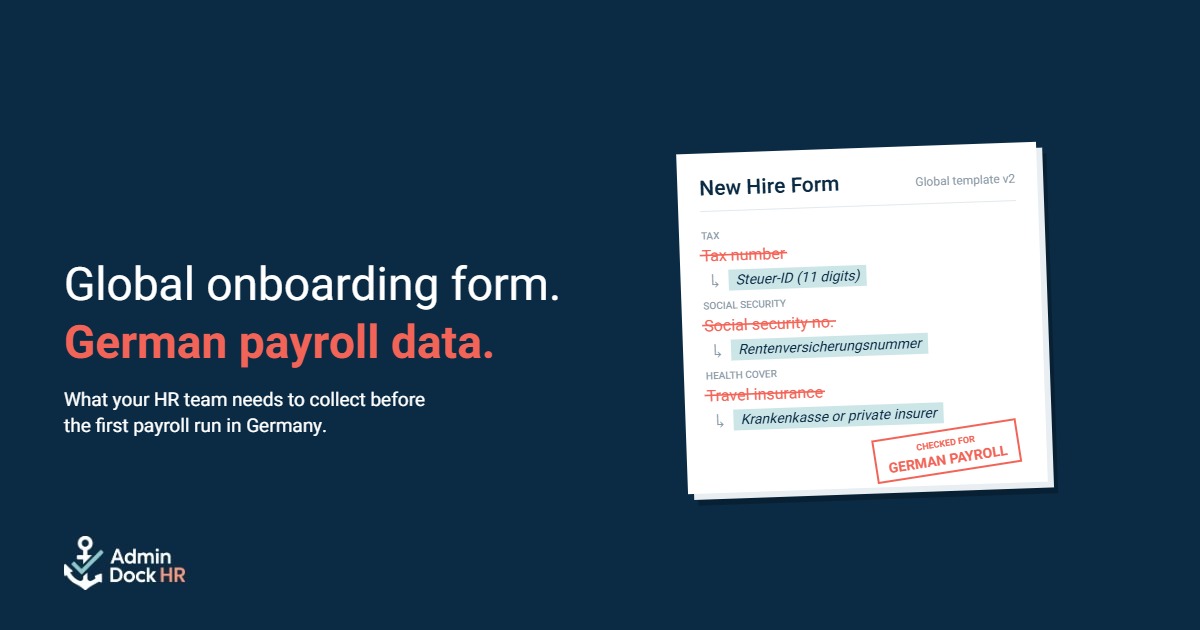
Your new hire in Hamburg starts on the 1st. The German payroll provider needs the data by the 20th. And they are asking for a Steuer-ID, a Krankenkasse and a Rentenversicherungsnummer: three fields your global onboarding tool simply doesn’t have.
We see this situation regularly with companies that are headquartered abroad and employ people in Germany. The German requirements are not complicated once you know them. But they don’t fit neatly into an international onboarding process, and small gaps quickly lead to a delayed first payslip or a correction run.
In this guide we explain which information you need, where employees find it, and where things typically go wrong. You can download our three bilingual questionnaires right away: for regular employees, for working students and for minijobs.
Free questionnaires, German and English
Fillable PDFs for regular employees, working students and minijobs. They collect everything payroll and personnel administration need, in both languages.
Who does what
Before the questionnaire goes out, agree on three things: who collects the data, who checks it, and who hands it over to payroll. The employee supplies personal, tax and insurance details. You as the employer supply the agreed employment terms. Payroll decides how those facts are treated in tax and social security.
Our practical tip: name one person who chases missing information, and work backwards from the payroll cut-off date. Employees should never have to pick payroll codes or classify themselves for social security. That is our job, not theirs.
What to collect
| Information | What it covers | Supplied by |
|---|---|---|
| Personal details | Legal name, name at birth, date and place of birth, address, nationality | Employee |
| Contact details | Private email and phone, emergency contact (optional) | Employee |
| Bank details | IBAN and account holder | Employee |
| Tax | German tax ID (Steuer-ID) and whether this is the main or an additional job | Employee |
| Health insurance | Statutory fund (Krankenkasse) or private insurer | Employee |
| Pension insurance number | Rentenversicherungsnummer, if the employee already has one | Employee |
| Education | Highest school and vocational qualification (needed for the social security report) | Employee |
| Previous employer | Direct insurance from the previous employer, capital-forming savings contract | Employee |
| Other jobs | Concurrent employment or self-employment, with hours and pay | Employee |
| Work abroad | Work in other countries, A1 certificate, residence and work permit | Employee and employer |
| Employment terms | Entity, start date, role, hours, salary, allowances, end date if fixed-term | Employer |
Information on religion, health or children has no place in a general questionnaire. Church tax and child allowances come electronically from the tax office, and parental status for care insurance is retrieved digitally by payroll.
Five mistakes we see again and again
- Tax number instead of tax ID. The Steuer-ID has 11 digits and stays with a person for life. The Steuernummer is something different: the reference for tax returns at the local tax office. And a Dutch BSN or a French numéro fiscal does not belong in the German field either.
- Travel insurance as proof of health cover. An international travel or expat policy is not automatically accepted for German payroll. We clarify early whether statutory or private cover applies.
- The immediate report is forgotten. In some sectors, such as construction, hospitality, cleaning, transport and logistics, the employee must be reported to social security no later than the first working day. HR teams abroad often don’t know this rule.
- The minijob without fixed hours. If a contract has no agreed weekly hours, German law assumes 20 hours a week. At the minimum wage this is well above the minijob limit, and the job becomes fully subject to social security from day one.
- The data arrives on day one. If the questionnaire goes out with the welcome pack, the first payroll run gets tight. We send it as soon as the contract is signed.
Tax ID, health insurance and pension number
Tax ID. For the electronic wage tax procedure (ELStAM), payroll needs three things: the tax ID, the date of birth and whether this is the main or an additional job. Tax class, child allowances and church tax are then retrieved electronically. Employees find their tax ID on the letter from the Federal Central Tax Office, on a previous German payslip or on their income tax assessment (ELSTER). No tax ID yet? Tell payroll straight away. Please never enter a placeholder just to fill a mandatory field.
Health insurance. We ask for the statutory health insurance fund or, for privately insured employees, the insurer. Private cover also matters for the employer’s contribution subsidy, so payroll will need a certificate from the insurer.
Pension insurance number. The Rentenversicherungsnummer is not the tax ID, even though employees often mix the two up. If the number is unknown, payroll requests it electronically before the registration. If no number exists yet, payroll triggers its assignment; for this, the place and country of birth are needed.
Working students
Working students (Werkstudenten) are popular with international companies. Payroll treatment depends on a few facts that we collect in a separate questionnaire.
The basics: during lecture periods, a working student may work no more than 20 hours a week in total, counting all jobs. Working more is possible in semester breaks, evenings or weekends, but only within limits that payroll checks (the so-called 26-week rule). If the conditions are met, there are no health, care or unemployment insurance contributions. Pension insurance still applies.
What we need from the student:
- A current enrolment certificate, every semester
- Study mode (full-time, part-time, distance learning) and expected end of studies
- All other jobs and self-employment, including hours over the past 12 months
- The date the final exam result is notified in writing, because the status ends at the end of that month
One more point: if the regular pay stays within the minijob limit, the job is assessed as a minijob. In that case, use the minijob questionnaire.
Minijobs and short-term employment
A minijob needs more than a shortened version of the standard form. Other jobs, health insurance and the employee’s status (pupil, student, pensioner, job seeker) all affect the assessment.
| 2026 | From 1 January 2027 | |
|---|---|---|
| Minijob earnings limit (regular, per month) | €603 | €633 |
| Statutory minimum wage (per hour) | €13.90 | €14.60 |
Predictable one-off payments such as a Christmas bonus count towards the forecast. Templates with older amounts should be updated now.
Pension insurance. Minijobbers can apply to be exempt from pension contributions. Since 1 July 2026 they can reverse that exemption once, for the future; after that, a new exemption is no longer possible (Minijob-Zentrale). Our questionnaire only asks whether an exemption is of interest. The application itself is a separate official form.
Short-term employment follows its own rules: generally up to 3 months or 70 working days per calendar year, in agriculture up to 15 weeks or 90 working days. Earlier jobs in the same year count. Above the minijob earnings limit, payroll also checks whether the person works on an occupational basis. That is why the questionnaire asks about previous jobs and periods registered as a job seeker.
Work across borders
Nationality alone tells payroll very little. What counts is where the person lives, where they physically work and whether they have other employment or self-employment abroad. Someone who regularly works in several EU countries may fall under another country’s social security system; an A1 certificate documents the outcome (DVKA).
If a residence or work permit is required, we check before the first working day that it covers this job, and we keep a copy. The questionnaire does not replace that check (Make it in Germany).
Data protection
We collect only what payroll and personnel administration actually need. Before the questionnaire goes out, employees receive a privacy notice under Article 13 GDPR. Completed forms travel through a secure channel, not as an email attachment. If an HR team outside the EU will access German employee records, this belongs in the company’s data protection assessment, including the rules for international transfers.
Before you hand over to payroll
- Personal details match the ID document and the contract
- Tax ID and main/additional job are filled in
- Health insurance is clarified, including proof for private cover
- Other jobs and work abroad are flagged
- Permission to work is checked where required
- Open items have an owner and a date
- Payroll confirms that it has everything for the first run
And after that: changes to address, insurance, other jobs or work location must reach payroll promptly.
Download our questionnaires
All three questionnaires are bilingual (German and English) and fillable as PDF. They are blank templates; please adapt them to your processes before use.
| Questionnaire | Covers | PDF (DE + EN) |
|---|---|---|
| Employee questionnaire | Regular employees: personal, tax and insurance data, direct insurance and capital-forming savings | Download PDF |
| Working student questionnaire | Study details and other activities | Download PDF |
| Minijob questionnaire | Minijobs and short-term employment: status, concurrent jobs, previous employment this year | Download PDF |
Each questionnaire collects information. It does not replace the employment contract, the statutory registration or the payroll assessment.
Frequently asked questions
Can we use our global onboarding form for employees in Germany?
Only with additions. German payroll needs the tax ID, the main or additional employment status, health insurance and, if available, the pension insurance number. Most global forms lack these fields.
What if a new employee has no German tax ID yet?
Tell payroll before the first payroll run. Without the tax ID, the electronic wage tax data cannot be retrieved. Never enter a placeholder or a foreign tax number instead.
Do working students and minijobbers need the standard questionnaire?
They need the standard data plus additional facts: enrolment and total working hours for working students, status and other jobs for minijobbers. That is why we provide separate questionnaires.
This article provides general information as of 24 October 2026. Tax, social security and immigration requirements depend on the individual case.
Hiring in Germany? We take care of it.
You run HR from Amsterdam, Copenhagen or London and have your first employees in Germany? We review the completed questionnaires, close the gaps, and prepare a clean handover to your payroll provider before the first payroll run. In plain English, with more than 30 years of German payroll experience behind us.
Tell us your start date, and we’ll tell you what’s still missing.