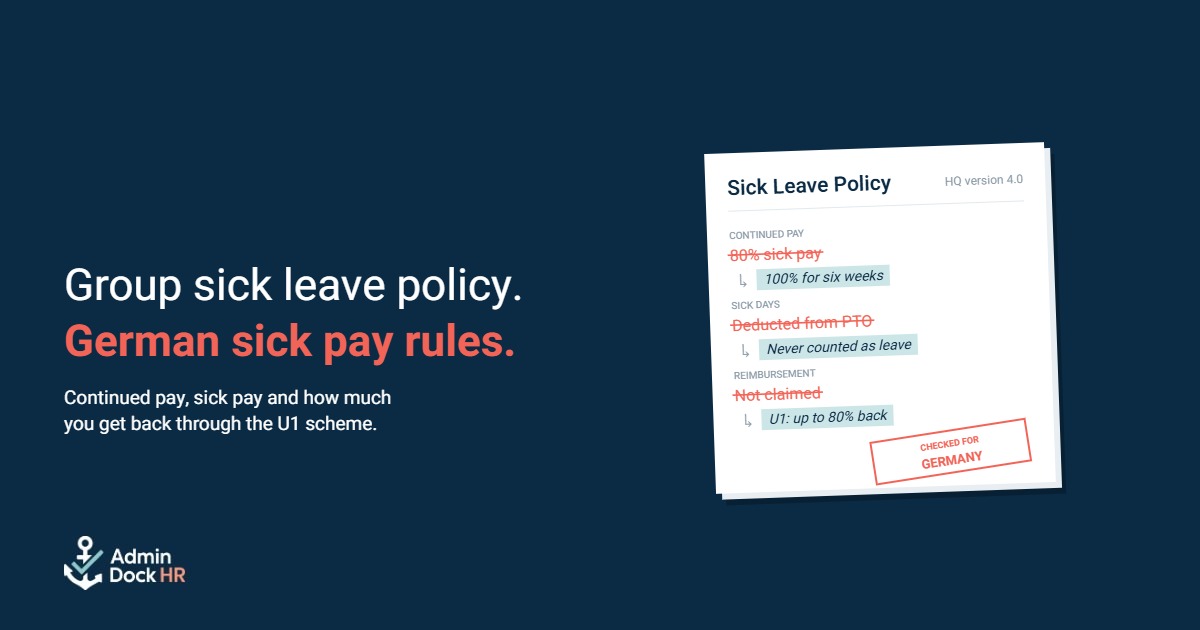
The group handbook says ten paid sick days a year, then 80 percent. In Germany, something else applies, whatever the headquarters policy says. The employer continues to pay full salary for six weeks of illness. After that, the health insurance fund takes over. And smaller companies get a large share of their costs back.
We often see two mistakes in practice: either too little is paid because of a group rule, or the subsidiary pays correctly but never claims the reimbursement. Both are easy to avoid. This article explains how sick leave works in Germany, who pays what, and when the health fund pays money back.
How long do you pay, and what do you get back?
Our free sick leave calculator shows in seconds when continued pay ends, when sick pay from the health fund starts, and how much you get back through the U1 scheme. It also covers repeated illness and the first four weeks of employment.
The first day: notification and proof
Anyone who is ill must tell the employer straight away, usually before work starts on the first day. If the illness lasts longer than three calendar days, a medical certificate of incapacity must be in place on the fourth day at the latest. If the fourth day is not a working day, the next working day is enough. The employer may ask for it earlier, even from day one, either in the employment contract or case by case.
Since 2023, this works electronically for statutorily insured employees. The doctor reports the incapacity to the health fund, and the employer or payroll provider retrieves the electronic certificate (eAU) from there. Employees only need to call in sick and see a doctor. Privately insured employees, certificates from doctors abroad and some special cases still use paper.
What is being discussed: In July 2026, the governing coalition agreed to abolish sick notes by phone and to require a certificate from the first day of illness. There is no law yet, and no start date has been set. Until then, the current rules apply. We will update this article as soon as anything changes.
Continued pay: six weeks of full salary
Under the Continued Remuneration Act (Entgeltfortzahlungsgesetz), the employer continues to pay for up to six weeks of incapacity, which is 42 calendar days. The employee receives what they would have earned in that time, without overtime pay. Reducing pay to 80 or 90 percent, as some group policies do, is not permitted in Germany.
- Waiting period: The entitlement only arises after four weeks of uninterrupted employment. The employer does not have to pay salary for sick days in the first four weeks. Statutorily insured employees receive sick pay from the health fund during that time. If the illness lasts beyond the four weeks, continued pay starts from then, for a full six weeks.
- Falling ill at work: If someone goes home during a working day, that day is paid as normal. The six weeks start the next day.
- A new illness during sick leave: If a second illness starts while the first is still ongoing, the six weeks are not extended. Only someone who was fit for work in between has a new entitlement for a different illness.
- Minijobs: The same rules apply to minijobbers and part-time staff.
Repeated illness: the six-month and twelve-month rule
It gets tricky when the same illness comes back, for example a back problem. The periods are then added up until the six weeks are used. A new six-week entitlement only arises if one of these conditions is met:
- The person was not off sick with this illness for at least six months.
- Twelve months have passed since the first sick leave for this illness began.
An example: an employee is off for 20 days in August with the same back problem and again in November. In November, the employer only pays for another 22 days; then the health fund takes over. The employer never sees the diagnosis. If in doubt, they ask the health fund whether it is a repeated illness. Our calculator handles exactly these cases.
After six weeks: sick pay from the health fund
When continued pay ends, the health fund pays sick pay (Krankengeld) to statutorily insured employees. Payroll sends the fund an electronic pay certificate for this. From then on, the employer has no more salary costs.
| Sick pay 2026 | |
|---|---|
| Amount | 70% of gross pay, at most 90% of net pay |
| Maximum | €135.63 gross per calendar day |
| Deductions | Pension, unemployment and long-term care contributions |
| Duration | at most 78 weeks within three years for the same illness |
The maximum is based on the health insurance contribution ceiling of €5,812.50 per month (TK). Privately insured employees receive no sick pay from a statutory fund, but possibly a daily benefit from their own policy. Minijobbers are not entitled to sick pay for their minijob.
The U1 scheme: money back for smaller employers
Six weeks of salary without work is expensive for a small team. That is why the U1 scheme exists. Employers with no more than 30 employees take part automatically. They pay a small contribution with every payroll run, and the health fund reimburses part of the continued pay in return.
- Who takes part: companies that had no more than 30 employees in at least eight months of the previous year. Part-time staff count proportionally: up to 10 hours a week as 0.25, up to 20 as 0.5, up to 30 as 0.75. Apprentices and severely disabled employees are not counted. For a GmbH, each company counts separately.
- How much comes back: depending on the chosen rate, usually between 40 and 80 percent of the continued gross pay. Without a choice, 70 percent usually applies. The higher the reimbursement rate, the higher the ongoing contribution.
- When to choose: once a year with each health fund, usually by the due date of the January contributions. The choice then applies for the whole calendar year.
- What is not reimbursed: pay beyond six weeks, one-off payments and pay during the first four weeks of employment. Many funds also only reimburse up to the pension insurance ceiling (€8,450 per month, 2026).
- How to claim: Your payroll provider files the claim electronically with the sick employee’s health fund, and the payroll software calculates the reimbursement automatically. You do not fill in anything yourself. What matters is that payroll hears about every sick leave. Claims expire after four years.
For minijobs, the Minijob-Zentrale handles reimbursement. It pays back 80 percent, and the contribution rate is 0.8 percent in 2026 (Minijob-Zentrale). Details such as whether employer social security contributions are covered are set out in each fund’s statutes (example: DAK).
An example: with a monthly salary of €4,200, six weeks of continued pay cost around €5,880. At a reimbursement rate of 70 percent, €4,116 comes back. Anyone who does not claim it is leaving that money on the table.
Four mistakes we see again and again in subsidiaries
- The end of continued pay is missed. This is the most common one. Neither the local manager nor HR at headquarters keeps track of the six weeks, and salary simply keeps running. Recovering the overpayment is tedious and strains the relationship with the sick employee. On top of that, the health fund lacks the pay certificate for sick pay.
- The group policy cuts pay. A PTO budget for sickness or continued pay at 80 percent is not permitted. Full pay applies for the first six weeks.
- The U1 reimbursement is never claimed. Especially when payroll sits abroad or HR at headquarters hears about sick days late, the reimbursement gets lost.
- Repeated illness is not checked. Without asking the health fund, employers often pay another six weeks although the time has already been used.
Frequently asked questions
May the employer ask about the diagnosis?
No. The certificate does not state a diagnosis. Whether an illness is a repeated one is clarified by asking the health fund.
What if someone falls ill on holiday?
With a medical certificate, the sick days do not count as leave. They stay in the leave balance and can be taken later.
Do minijobbers get continued pay?
Yes, under the same rules. The 80 percent reimbursement runs through the Minijob-Zentrale.
Does U1 also cover maternity?
No, that is the U2 scheme. All employers take part regardless of size, and it reimburses the costs in full.
This article provides general information as of 25 October 2026. Collective and employment agreements may contain more generous rules. Individual cases depend on the circumstances and the statutes of the health fund.
Handle sick leave properly, without leaving money behind
We keep track of the deadlines for your German company, trigger the pay certificate for sick pay, and make sure the U1 reimbursement is claimed. In English or German, aligned with your payroll provider.