In a German subsidiary, German leave law applies, whatever the group policy says. That sounds obvious. Yet we often see leave rules copied straight from headquarters: a US-style PTO bank, hours instead of days from the Netherlands, public holidays counted as annual leave as in the UK.
As long as nobody asks, this goes unnoticed. It gets expensive when someone leaves, moves to part time, or when unused leave fails to expire for years. This article shows where German law differs from the rest of Europe and the US, and what to check in your policy.
Want to check a case?
Our free annual leave calculator shows in seconds how many days a part-time employee is entitled to, including joining, leaving or changing working days during the year.
The EU framework and what Germany makes of it
Article 7 of the EU Working Time Directive (2003/88/EC) requires at least four weeks of paid annual leave. Each member state implements it separately. In Germany, this is the Federal Leave Act (Bundesurlaubsgesetz, BUrlG).
- Days, not hours. The BUrlG grants 24 working days based on a six-day week. For a five-day week, that is 20 days, exactly the four weeks of the directive.
- Public holidays come on top. Public holidays never count as leave days and cannot be deducted from annual leave.
- Waiting period. The full entitlement applies after six months of employment (Sec. 4 BUrlG). Before that, leave accrues pro rata.
- Extra leave is common. Many contracts grant 25 to 30 days. For the part above the minimum, the contract or a collective agreement can set its own rules, for example on expiry or pro-rating on joining and leaving.
The EU Part-time Work Directive (97/81/EC) adds that part-time employees get leave pro rata but must not be treated less favourably than full-time staff. This is why German law does not allow a simple recalculation when someone moves to part time.
Germany compared
The biggest differences are not in the number of days, but in how leave is counted and when it expires.
| Country | Statutory minimum | Counted in | Part time | Public holidays | Expiry |
|---|---|---|---|---|---|
| Germany | 20 days for a 5-day week (24 working days) | working days | pro rata by days per week | on top | 31 Dec, 31 Mar if carried over, but only after the employer’s notice |
| Netherlands | 4 × weekly hours, i.e. 160 hours at 40 hours a week | hours | pro rata by hours | on top | statutory leave 6 months after year end, extra leave after 5 years |
| France | 2.5 working days per month, 30 per year (5 weeks) | working days (Monday to Saturday) | same as full time | on top | by reference period and collective agreement |
| United Kingdom | 5.6 weeks, capped at 28 days | days | days per week × 5.6 | may be included | usually at the end of the leave year, exceptions e.g. for sickness |
| United States | no statutory entitlement | company policy, often hours | company policy | company policy | company policy |
This is where the usual misunderstandings come from. 30 days in France are about 25 working days in Germany. 28 days in the UK may already include public holidays. A Dutch part-time entitlement in hours does not match German payroll, which counts days.
Part time: count days, not hours
In Germany, leave depends on the number of working days per week, not on hours:
Leave days = full-time leave × own working days per week ÷ full-time working days per week
With 30 days of full-time leave and three working days a week, an employee gets 18 days. Whether those days are four or eight hours long makes no difference. Someone working five four-hour days keeps all 30 days.
Moving between full time and part time during the year. Following the CJEU and the Federal Labour Court (BAG, 10 Feb 2015, 9 AZR 53/14), each period is calculated separately. Leave earned in full time is not reduced afterwards when the employee moves to part time. Example: 30 days of leave, from 1 July a change from five to four days a week. That gives 15 days for the first half and 12 for the second, 27 days in total.
Joining or leaving during the year. Employees who start after 1 July, or leave by 30 June, get one twelfth of the annual leave for each full month (Sec. 5 BUrlG). Fractions of half a day or more are rounded up.
Our annual leave calculator works through these cases in seconds, including changes in working days and additional leave for severely disabled employees.
Five common mistakes in group policies
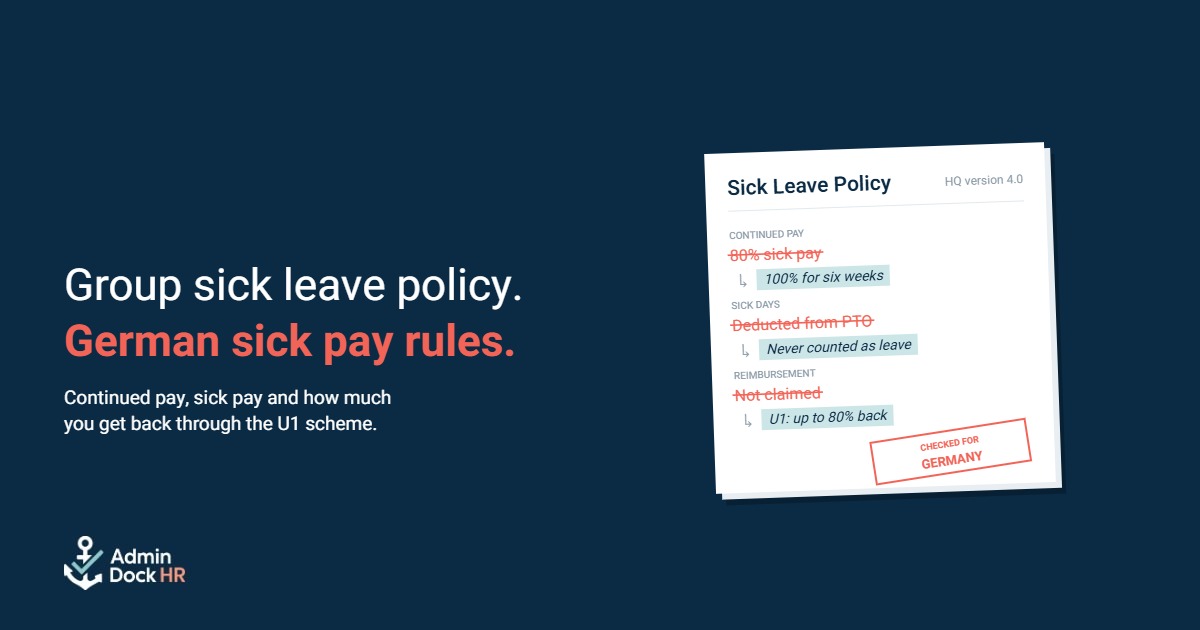
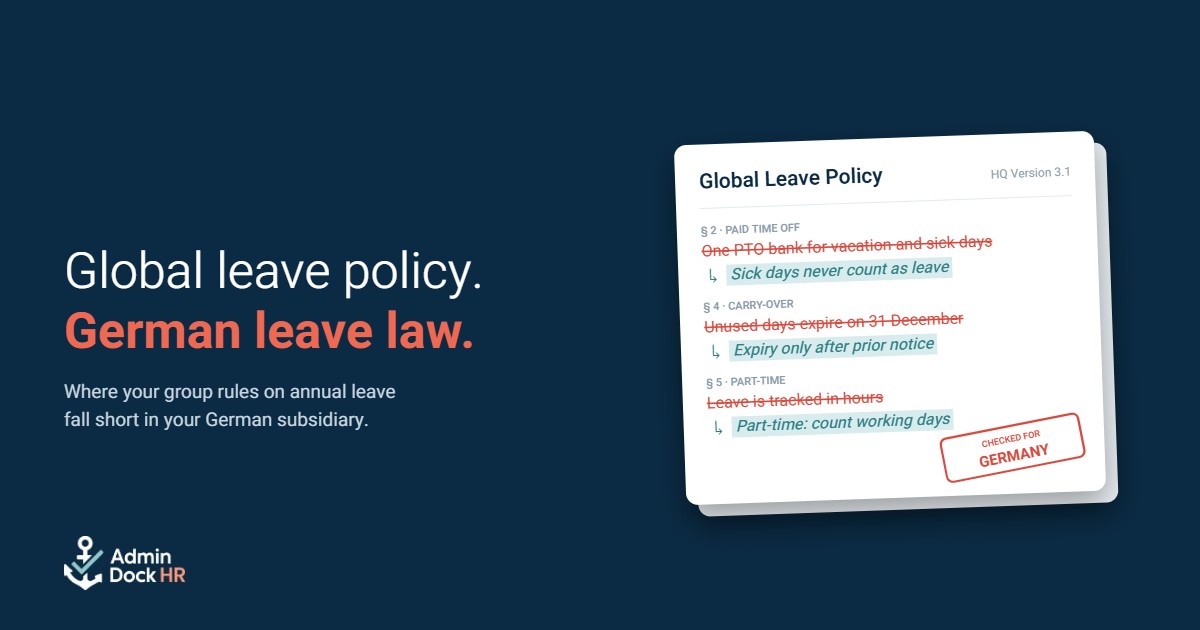
1. One PTO bank for leave and sickness. US policies often combine vacation, sick days and personal days. In Germany, this is not allowed. Sickness is never deducted from annual leave. Employees who fall ill during their holiday and provide a doctor’s note get the days back (Sec. 9 BUrlG).
2. “Unused leave expires on 31 December.” Only if the employer has first told the employee how much leave is left, asked them to take it, and warned that it will otherwise expire. Without this notice, leave carries over and can build up for years (CJEU, 6 Nov 2018, C-684/16; BAG, 19 Feb 2019, 9 AZR 541/15). It is then paid out in full when the employee leaves.
3. Unlimited PTO without a minimum. “Take as much leave as you need” does not replace a fixed entitlement. The statutory minimum must be defined, recorded and actually available to take. Otherwise the notice duty from point 2 applies again.
4. Paying out leave instead of granting it. While employment continues, statutory leave cannot be paid out. Payment in lieu is only allowed when employment ends and the leave can no longer be taken (Sec. 7 (4) BUrlG).
5. Leave in hours instead of days. Thinking in hours, as in the Netherlands or the US, quickly shortchanges part-time employees with short days. In Germany, the number of working days per week counts, not the hours.
Checklist for your leave policy in Germany
- Is leave defined in working days, with at least 20 days for a five-day week?
- Are public holidays granted on top and not deducted from leave?
- Are leave and sickness handled separately?
- Is there a written notice every year on remaining leave and expiry, in good time before year end?
- Does the policy say what happens to extra leave above the statutory minimum, for example on expiry and when joining or leaving?
- Is part-time leave converted by working days, and is leave from full time kept when someone changes?
- Is leave only paid out when employment ends?
If you are unsure on any point, look at the leave balances of the past few years. Leave that keeps piling up is often the first sign that the group rule does not work in Germany.
Frequently asked questions
How many days of annual leave do part-time employees get in Germany?
The same as full-time staff, converted to their working days per week. With 30 days of full-time leave and three working days a week, that is 18 days. Hours per day make no difference. You can work out your own case with our annual leave calculator.
Can headquarters set its own leave policy for the German subsidiary?
Yes, as long as it does not fall below German law. More leave and better terms are always possible. Less than the statutory minimum, or deductions for sickness or public holidays, are not.
Does unused leave expire at the end of the year in Germany?
Only if the employer has first pointed out the specific remaining leave and the risk of expiry. Without this notice, the leave remains and must be paid out when the employee leaves.
Is unlimited PTO possible in Germany?
It is possible, but it does not replace a fixed minimum. The employer must record statutory leave and make sure it can be taken.
What happens to leave when an employee moves from full time to part time?
Leave earned in full time up to the change is kept in full. From the change onwards, leave is calculated on the new working days.
Leave rules that work in Germany
AdminDockHR runs HR for German subsidiaries of international companies, in English and German. We check your leave policy against German law, adapt it together with your headquarters and keep an eye on leave balances. For existing companies, our Compliance Check is a good starting point: it shows where your German subsidiary stands today.